Live UFC Betting: An In-Play Strategy Guide for UK Bettors
 Available in US
Table of Contents
- Live UFC betting is a different market with its own clock
- What the live engine actually sees during a round
- Why your bet sits in the queue for seven seconds before it lands
- The sixty seconds between rounds is the cleanest window in UFC betting
- Cash out, partial cash out, auto cash out — what each one actually does
- The in-play shelves nobody on UK Twitter talks about
- Bankroll rules I follow inside a live UFC bout
- Five tilt traps that empty live UFC accounts
- Quick answers about live UFC betting
- The three habits that keep live UFC betting profitable
Live UFC betting is a different market with its own clock
The first time I cashed a live UFC ticket between rounds, my hands were shaking. Not from nerves about the bet — from realising I had just made a decision in sixty seconds that would normally take me three days of analysis. Live UFC betting is not the same product as the pre-fight market with a different clock attached. It is a separate market with its own bet delay, its own margin structure, its own decision rhythm, and its own brutal feedback loop. Treat it as the moneyline market with a faster pulse and you will lose money in patterns you cannot identify.
The numbers behind the rise of in-play UFC are striking. The US MMA betting handle hit $10.3 billion in 2024, up 17 per cent year on year, and a meaningful slice of that volume is live rather than pre-fight. The UK in-play market is smaller in absolute terms but follows the same trajectory and the same psychology. This guide is the working version of what I have learned about it across eleven years of UFC wagering, with the operational mechanics that the typical UK punter does not see until they are losing money on them.
See also: how do i bet on ufc fights for pre-fight and in-play resources.
What the live engine actually sees during a round
Three years ago I watched a UFC welterweight bout where the favourite landed a clean takedown thirty-five seconds into round two and ended up underneath his opponent for the rest of the round. The live odds on him to win extended out from 4/9 to 11/8 in those five minutes, even though he was technically winning the takedown statistic. The reason is that the live odds engine was not modelling who landed the takedown. It was modelling who would survive being in that position for the next four minutes, with damage being absorbed, cardio being burned and the second fighter’s submission attempts threatening the fight in real time.
The live engine reads the fight along four axes. Damage absorbed is the first — significant strikes landed, head versus body, accumulated facial swelling, cuts. Takedown state is the second — who is on top, how dominant the position, time on the mat. Cardio depletion is the third — visible signs of fatigue, breathing patterns, defensive posture, lowered hands. Time profile is the fourth — what the model expects to happen in the next ninety seconds given the previous ninety. The combination drives a price tick that updates every three to five seconds during live action, with momentary suspensions during significant events like knockdowns or scrambles.
The reason the engine matters to you as a UK bettor is that its perspective is different from yours. You are watching the fight as a viewer, with emotional attachments and visual intuitions. The engine is reading a data stream that includes objective measurements you cannot see in real time — punch impact data from arena sensors on the major events, exact positional time logs, finish-attempt counts. When the engine’s price disagrees with your read, the disagreement is information. Sometimes you are right. Sometimes the engine has spotted something you missed.
The growth of partnerships between UFC and integrated operators has accelerated this dynamic. The bet365 deal, announced in March 2026 and described by the operator’s leadership as a defining moment for accelerating growth around sports where live action and fan engagement are inseparable, was structured specifically around the always-on UFC event calendar and the appetite for real-time engagement. The product side of that partnership — deeper in-play markets, richer data feeds, smoother live betting interfaces — is what UK readers see on their app. The pricing side is what determines whether the live odds you take are a real edge or a real trap.
Why your bet sits in the queue for seven seconds before it lands
Bet delay is the single most under-discussed mechanic in UK in-play betting. When you click a live UFC price and confirm your stake, the bet does not register immediately. It sits in a queue for between three and seven seconds — the exact delay varies by operator, by market, by the moment-to-moment volatility in the fight — and only then does the bookmaker accept it. If the price moves during the delay, your bet is rejected or re-offered at the new price. If a significant event happens during the delay, like a knockdown, the entire market suspends and your bet falls into the void.
The reason bet delay exists is that arena video feeds reach different viewers at different latencies. A punter in the arena sees a knockdown live. A punter watching the linear broadcast sees it eight to ten seconds later. A punter on a streaming service might see it fifteen seconds after that. Without a bet delay, the in-arena viewer would have a free informational edge over the broadcast viewer, and the operator would lose money on every significant moment in every fight. Bet delay is the equaliser.
For your in-play strategy, bet delay has two practical implications. First, the price you clicked is not necessarily the price you will get. If you are clicking a fast-moving odds tick mid-action, expect to be re-offered. The discipline is to set a maximum acceptable price drift in your head before you click — usually one full price band of movement — and to walk away if the new offer is worse than the threshold. Second, the moment of action is not the moment to bet. If you see a knockdown live, the market is already suspended and you cannot bet on the consequences. The window to bet is before the action, not during it.
Bookmakers also use momentary suspensions on what they classify as significant events even when no knockdown has happened. A takedown attempt in progress, a scramble on the ground, a fighter pinned to the cage — all of these can trigger a brief market freeze while the engine recalibrates. The suspension typically lasts five to fifteen seconds. During that window, no bets are accepted on the affected markets. You will see the price disappear and reappear with a new number on the other side of the event.
The sixty seconds between rounds is the cleanest window in UFC betting
Of the 43 UFC events on the calendar each year — 13 numbered shows and 30 Fight Nights — every single one produces multiple between-round windows that are the single best in-play betting opportunity in the sport. The window between the bell at the end of one round and the bell at the start of the next is exactly sixty seconds. During those sixty seconds, the live odds engine has stable inputs, the market is generally open, and you can think clearly about what just happened and what is likely to come next.
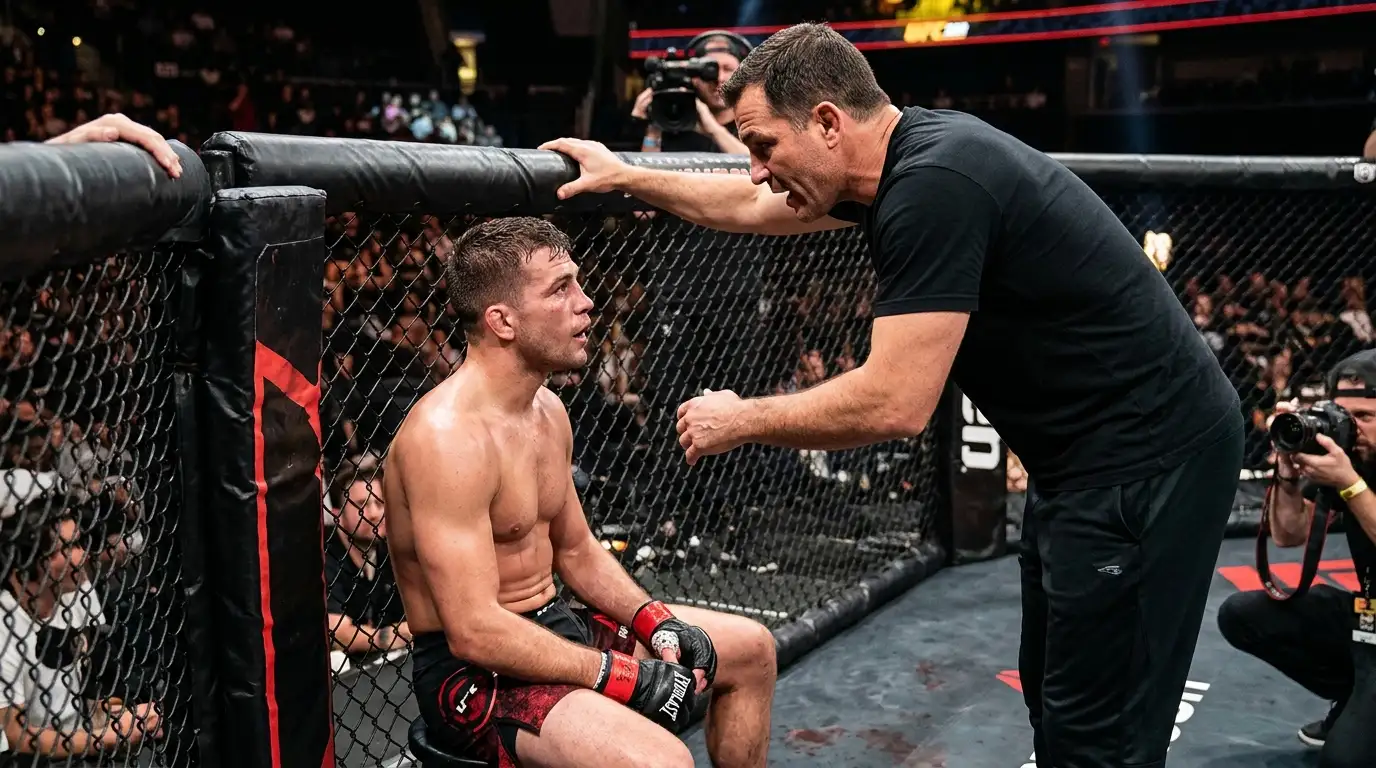
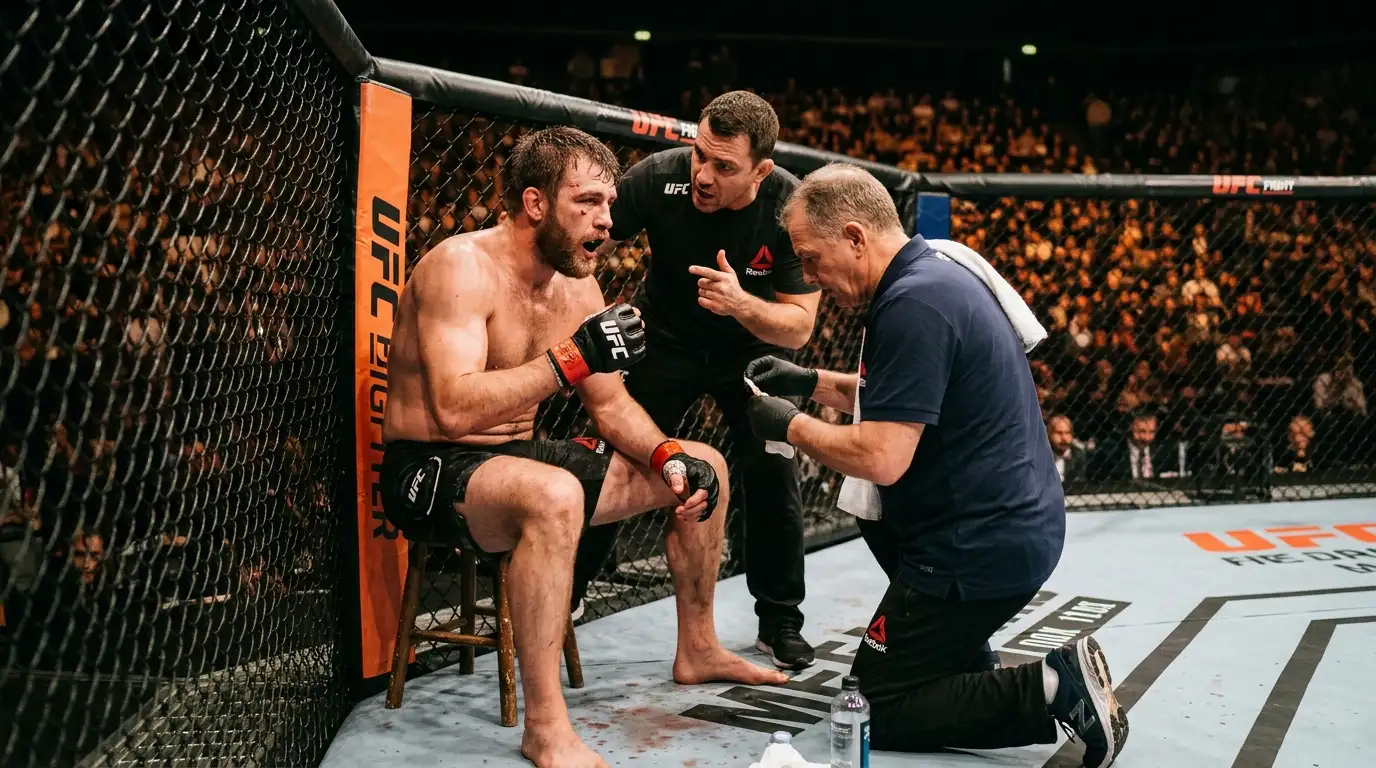
The reason this window outperforms mid-round betting on every dimension is that the action is stopped. The fighters are in their corners. The coaches are speaking, the cutmen are working, and the round-by-round damage state has stabilised. The live odds engine has just finished processing a five-minute block of data and produced a clean tick. Your read of the fight has the same five minutes to process, plus visual access to the corner instructions if the broadcast is showing them. Both you and the engine are reading the same situation with maximum context.
The tactic I use is “wait for the corner”. Pre-fight, I identify two or three bouts I am actively interested in betting in-play. During round one, I watch without touching the app. At the bell, I take fifteen seconds to write a one-line read of what I just saw — who is up, who is fading, what changed. Then I open the live market, compare the price to my read, and either bet, pass, or note the disagreement for round two. The whole process takes twenty seconds. The remaining forty seconds of the inter-round window are spent watching the corners.
What this tactic protects against is the mid-round emotional bet. Mid-round odds move fast, the visuals are vivid, and the temptation to bet at the peak of a sequence is enormous. Most in-play losses I have made over the years happened when I bet inside the round on a sequence I had not planned to bet on. The inter-round discipline is the simplest framework for keeping the impulse bets out of the bankroll.
The exception worth knowing is championship rounds. Five-round main events have a final ninety seconds of round five that is unlike anything else in UFC. If the fight is close on the cards and both fighters know it, the desperation-to-finish dynamic produces some of the largest live odds swings in the sport. Betting that ninety seconds is gambling unless you have a very specific read on what each fighter will do.
Cash out, partial cash out, auto cash out — what each one actually does
Cash out is not a price. It is an operator offer to buy back your existing position at the current implied value, less their margin. Understanding that distinction is the foundation of every cash-out decision you will ever make. The number on your screen is what the bookmaker is willing to pay you right now to settle the bet immediately. It is not the fair value of your ticket. It is the fair value minus the cash-out margin.
Full cash out closes the entire position. You took 4/1 on Fighter A pre-fight, Fighter A is now up two rounds to nil, and the cash-out offer is, say, 2.40 times your original stake. You can click the button and walk away with twice your stake immediately, regardless of what happens in round three. The trade-off is that you have left the upside on the table. If Fighter A wins the decision, you would have collected five times your stake. Cashing out at 2.40 was a hedge, not a profit.
Partial cash out lets you take some of the position off and leave the rest live. The mechanics are identical to full cash out, applied to a fraction. The UK bookmakers I use most often default to 50 per cent partial cash outs, but most allow you to set the fraction yourself. Partial cash out is the right tool when your read of the live state has changed but not flipped — you still think your bet wins, but with less confidence than when you placed it.
Auto cash out is a pre-set rule: if the cash-out offer reaches a specific number, the bet closes automatically. Useful when you are betting a card and not watching live, or when you know you are likely to make emotional decisions in real time and want to remove yourself from the loop. Auto cash out is one of the simplest behavioural tools in UK in-play, and most readers under-use it.
The deeper question of when to deploy each cash-out tool — and when to do nothing and ride the bet to the final bell — is a topic that sits at the centre of in-play discipline. Our piece on when to take a cash-out and when to ride it walks through the specific decision framework with worked examples from recent UFC bouts.
The in-play shelves nobody on UK Twitter talks about
The in-play UFC market has four shelves beyond the live moneyline that are routinely under-priced because the casual UK punter does not bet them. Next Round to Finish is the headline among them. It pays out if the fight ends in the named round, with the live price updating round-by-round based on the current state of the fight. Heavyweight Next Round to Finish prices drift up sharply if round one ends with both fighters still standing, because the structural finish rate in heavyweight — 67 per cent inside the distance — concentrates so heavily in round one that the market re-prices the remaining rounds as elevated finish opportunities.
Round Winner is the second shelf, paying out on which fighter wins the next round on the judges’ cards. It is functionally a moneyline on a five-minute slice of fight, with the price reflecting the current state plus the previous round’s evidence. Round Winner is sharp on competitive bouts where the live moneyline has tightened to near-coin-flip and one fighter is showing late-round momentum the engine has not yet fully priced.
Next Significant Strike pays out on which fighter lands the next strike classified as significant by the scoring algorithm. It is the highest-variance shelf on the in-play menu — a single exchange can settle it — and it is the one I recommend most against for new live bettors, because it rewards luck more than read.
Total Takedowns is the fourth shelf, paying out on whether the cumulative takedown count crosses a line during the bout. It is the in-play shelf that benefits most from study, because takedown patterns are extremely fighter-specific and the live model often anchors to round one’s takedown count when round two’s profile is likely to differ. A wrestler who shot once in round one but is known for high-volume wrestling can have a Total Takedowns over line that is mispriced because the model is too conservative.
Bankroll rules I follow inside a live UFC bout
The biggest mistake I see UK punters make in live UFC is staking in-play tickets at the same unit size as their pre-fight bets. The volatility is wrong. A pre-fight moneyline at 4/9 has variance you can calculate from the implied probability and a long sample. A live moneyline at the same number, three minutes into round one, has variance you cannot calculate cleanly because the underlying state of the fight is uncertain. Same nominal price, different actual risk profile.
My standing rule is to size in-play tickets at half a percentage point of bankroll. If a typical pre-fight ticket is one per cent of my bankroll, my typical in-play ticket is half that. The reasoning is bankroll preservation across a season of live betting, where the variance compounds faster than the average punter expects and where one bad night of three tilt bets can wipe out a month of patient gains.
The rule has a behavioural pair: no chasing. If a live bet loses, the next live bet does not get bigger to recover the loss. The cardinal sin of in-play betting is the cash-out loop — cashing out a losing position at a loss, immediately re-staking on the opposite side, watching that lose, and re-entering the original side at a worse price. I have done all three in a single fight, in 2019, and the damage that night still informs how I size every live bet I make. The cash-out loop turns one losing bet into three, and the cumulative loss is rarely recoverable inside the same fight.
The context for these rules matters. Around one in twenty British adults aged 18 to 24 are at the highest measured level of problem gambling severity — 5.3 per cent at the PGSI 8-plus band. In-play betting is the gambling product that contributes most heavily to that profile. The bankroll rules above are not just about preserving your money. They are about preserving the version of you that can keep betting sustainably for the next ten years rather than the next ten months.
Five tilt traps that empty live UFC accounts
Trap one is the “price looks better than it should” trap. A live odds price that seems too generous is rarely a market mistake; it is the engine pricing in something you have not noticed yet. Twice the gift price means twice the risk.
Trap two is the “he is definitely about to finish” trap. Mid-round, a fighter teeing off on a wobbled opponent looks like an imminent finish. Half the time the wobbled opponent recovers and survives the round. The live odds engine knows the survival rate; you are watching the visuals and over-weighting the recent few seconds.
Trap three is using cash out to cover a losing bet. If your bet is losing badly and you cash out to “save what is left”, you have crystallised a loss at the worst possible price point. Cash out is for managing winners or genuine read changes, not for psychological relief on losers.
Trap four is the cash-out loop, described in the previous section. If you have cashed out once mid-fight, the rule is to walk away from the live market for that bout. Re-entering after a cash out is almost always tilt.
Trap five is the late-round Hail Mary. Backing the underdog at a long live price in the last sixty seconds of the final round, because “anything can happen”. Across enough samples, almost nothing happens, and the long price is long for a reason.
See also: heavyweight bouts shift quickly live — read our heavyweight betting patterns analysis.
Quick answers about live UFC betting
The three live-market questions below come up in almost every conversation I have with newcomers to in-play UFC. Each one is the kind of mechanical detail that the apps do not explain in their own interfaces.
Live odds tick every three to five seconds during active rounds, with the exact frequency depending on the operator and the volatility of the fight. Significant events like takedowns, knockdowns, or scrambles trigger a momentary market suspension, typically five to fifteen seconds, during which the engine recalibrates and no bets are accepted on the affected markets. Between rounds the market is stable and open, which is why most disciplined in-play bettors place their tickets during the 60-second inter-round window rather than mid-action. Yes, on every major UK operator that offers UFC cash out. The inter-round window is in fact the cleanest moment to take a cash-out decision because the live odds engine has stable inputs and your read has had a full round of evidence to settle. Most books display the cash-out offer continuously through the inter-round period. A small number of books temporarily suspend cash out during the round buzzer transitions; if yours does, the offer will reappear within ten to twenty seconds of round two starting. Bet delay is the three-to-seven-second pause between clicking confirm on a live UFC bet and the bet actually registering with the bookmaker. The delay exists to equalise the timing edge between in-arena viewers, linear broadcast viewers and streaming viewers, all of whom see the action at different latencies. If the live price moves during the delay or if a significant event occurs, your bet is re-offered at the new price or rejected entirely. Plan accordingly — set a maximum acceptable price drift before clicking.How fast do UFC live odds update during a round?
Can I cash out a live UFC bet between rounds?
What is bet delay on UFC live markets?
The three habits that keep live UFC betting profitable
Three habits to carry into the next live UFC card. Bet between rounds, not during them — the inter-round window is the cleanest decision environment in the sport, and disciplining yourself to wait for it removes the majority of impulse losses. Stake live tickets at half your pre-fight unit size, because in-play variance is genuinely higher and bankroll preservation is what allows you to bet next month. Use cash out as a tool for managing winners and genuine read changes, never as a psychological relief valve for losing positions.
Live UFC betting will not make you rich quickly. It can make you marginally sharper across a season if you respect the mechanics, the maths and the bankroll. Twelve fights a card, forty-three cards a year, twenty inter-round windows on most events — that is the surface area on which a disciplined live UFC strategy compounds. Treat it that way and the long-run return follows.
Published by the how do i bet on ufc Fights team.